Mumbai:- A city of dreams, a city which is known for never stopping no matter whatever happens. To keep this unstoppable Mumbai run continuously, It’s Public Transport System plays a major role. Let’s have a look at the various modes of Public Transport:-
- Railways:- Railways are considered to be the lifeline of Mumbai. Mumbai Suburban Railway consists of exclusive inner suburban railway lines augmented by commuter rail on main lines serving the Mumbai Metropolitan Region. Spread over 465 kilometers , the suburban railway operates 2,342 train services and carries more than 7.5 million commuters daily. By annual ridership (2.64 billion), the Mumbai Suburban Railway is one of the busiest commuter rail systems in the world and it has the most severe overcrowding in the world. Trains run from 04:00 until 01:00, and some trains also run up to 02:30.The Mumbai Suburban Railway system is operated by Indian Railways’ two zonal divisions Western Railways (WR) and Central Railways (CR). The fast commuter rail corridors on Central Railway as well as Western Railway are shared with long distance and freight trains, while inner suburban services operate on exclusive parallel tracks.
Central Line:-
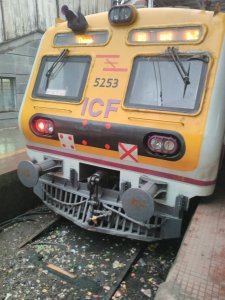 The Central Line in Mumbai consists of 3 major corridors, which bifurcate as they run into suburban satellite towns. Two corridors (one local and other through) follow the Central Railway run from Chhatrapati Shivaji Maharaj Terminus (CSMT) to Kalyan (54 km), from where it bifurcates into two lines – one to Kasara (67 km) in the north-east and the other to Khopoli (61 km) in the south-east. These two corridors constitute the ‘main’ Central Line. There is also an 18-km corridor between Kurla and Thane stations for use of outstation and cargo trains. The outstation corridor is being extended further from Thane to Kalyan now as a part of the main line,
The Central Line has two interchange stations with the Western Line at Parel and Dadar. Rolling stock consists of a fleet of Siemens E.M.U. as well as Bombardier Transportation E.M.U. The major car sheds on this line are at Kurla and Kalwa. There are fast and slow locals here for suburban service. Slow locals halt at every station, while fast locals halts vary. All services plying beyond Kalyan run as slow service (halting at every station).
The Central Line also includes a line connecting Vasai Road-Bhiwandi Road- Diva and Panvel.
Western Line:-
The Western Line follows the Western Railway northwards from Churchgate parallel to the west coast. Local services by electric multiple units (EMUs) ply between Churchgate and Dahanu Road (124 km) on exclusive parallel tracks up to Virar (60 km) . MEMUs also operate between Dahanu Road and Panvel via a branch line from Bhiwandi road-Vasai Road. There are EMU carsheds at Mumbai Central, Kandivali and Virar. The largest EMU car shed in Asia is located at Virar. A repair shop for EMUs is situated at Mahalaxmi.
Western Railway’s EMU fleet consists of E.M.Us completely powered by alternating current (25 kV) power. E.M.Us are 12 car or 15 car formations and are differentiated as slow and fast locals. Slow trains halt at all stations, while fast ones halt at important stations only and are preferable over longer distances.
Harbour Line:-
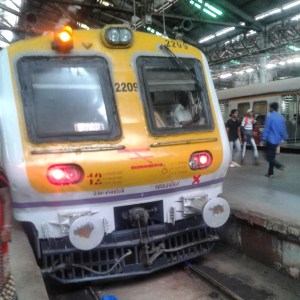 The Harbour Line is part of the Central Railway, and runs from Chhatrapati Shivaji Maharaj Terminus (CSMT) to Goregaon and Panvel. All Harbour Line services operate as slow services. The line operates from two separate platforms at Chhatrapati Shivaji Maharaj Terminus (CSMT), and the tracks cross over the main line at Sandhurst Road, to head towards stations along Mumbai’s eastern dock area. A branch line from Wadala Road joins the Western Line at Mahim and continues towards Goregaon.
The Harbour Line has an interchange station with the main line at Kurla, where it turns east towards Navi Mumbai. The Harbour Line further bifurcates at Vashi into two lines – one rejoins the main lines at Thane, while the other continues to Panvel. The shed for these trains is in Sanpada. A partial section of the Harbour Line is elevated.
Trans- Harbour Line:- The Trans-Harbour Line connects Navi Mumbai to Thane. It runs from Thane to Vashi, Nerul and Panvel.
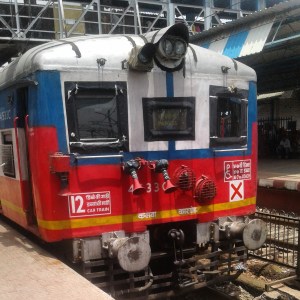 Trans- Harbour Line Local
Nerul-Uran Line:- It runs from Nerul and SeawoodsDarave to Uran.
2. Buses– Just as Locals, buses are also considered to be the lifeline of Mumbai. In Mumbai Metropolitan Region, there are Few Municipal Corporations which operates Bus service which connects parts of Mumbai to their cities. Popular Bus services in Mumbai are:-
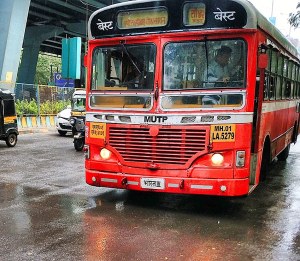
- Brihanmumbai Electric Supply and Transport( B.E.S.T.) :- Operated by Brihanmumbai Municipal Corporation, B.E.S.T. is one of the biggest Bus Service available in Mumbai which connects Mumbai to Thane, Navi Mumbai and Mira Bhayander through its network of nearly 700 Routes.
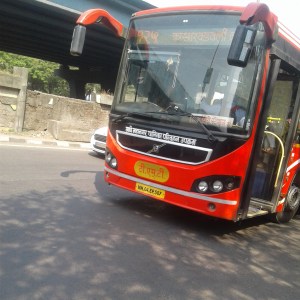 Volvo manufactured bus operated by T.M.T.
- Thane Municipal Transport(T.M.T.) :- Operated by Thane Municipal Corporation, T.M.T. operates in Thane and some parts of Mumbai like Mulund, Andheri, Borivali and Mira Road
- Navi Mumbai Municipal Transport(N.M.M.T.):- Operated by Navi Mumbai Municipal Corporation, it operates in Navi Mumbai and connects South Mumbai, Dombivali, Thane.
- Mira Bhayander Municipal Transport(M.B.M.T.):- Operated by Mira Bhayander Municipal Corporation, it operates in Mira Bhayander, Borivali, Thane.
- The Maharashtra State Road Transport Corporation( M.S.R.T.C.) operates its city service in Thane, Borivali, Navi Mumbai, Kalyan through ordinary buses and Air Conditioned Bus Service known as Shivshahi.
3. Metro Rail:-
Mumbai Metro is a rapid transit system serving the city of Mumbai, Maharashtra. The system is designed to reduce traffic congestion in the city, and supplement the overcrowded Mumbai Suburban Railway( local trains) network. It is being built-in three phases over a 15-year period, with overall completion expected in 2025. When completed, the core system will comprise eight high-capacity metro railway lines, spanning a total of 235 kilometres (24% underground, the rest elevated) and serviced by 200 stations.
As of August 2018, Mumbai metro consisted of 1 operational line (Line 1 – elevated metro from Versova to Ghatkopar), and 4 lines under various stages of construction.
4. Mono Rail:-
Mumbai Monorail is a monorail system in the city of Mumbai, Maharashtra, built as part of a major expansion of public transport in the city. The project is implemented by the Mumbai Metropolitan Region Development Authority (MMRDA). The system started commercial operation after partially opening its Phase 1 to the public in 2014.
5. Auto Rickshaws And Taxis:-
Taxis
Taxis arrived in 1911 to complement horse cars. Black and yellow Fiat taxis are an integral part of the city’s heritage and have been depicted in numerous Bollywood movies. Metered taxis ply throughout Mumbai from Bandra to Churchgate on the Western line and Sion to Chatrapati Shivaji Terminus on the Central line.
Rickshaws
Auto rickshaws play an important role in public transport in Mumbai. Since 2002, all auto rickshaws have been required to use CNG as fuel . Mumbai MMRDA extends up to Thane , Alibag, Badlapur, Kalyan and Ulhasnagar.
Auto rickshaws are not permitted to enter Old Bombay. The southernmost points accessible to them are Bandra Fire Station in Western Mumbai and Sion Bus Depot in Central Mumbai.
6. Ola And Uber:- Ola And Uber can be considered as the future of public transport in Mumbai. People in Mumbai started preferring Ola And Uber because of notorious behaviour of Metered Autos And Taxis. One can get a ride by sitting anywhere and booking a ride. Ola And Uber have started providing services like Ola/Uber Auto, Cabs, Outstation Cabs, Rental Cabs.

 Mumbaitravel